- Email helpdesk@brainsbuds.com
- Phone +92 306 3453603

Intellect International Montessori School nurtures young minds with a Montessori-based approach, fostering creativity, independence, and lifelong learning.
Monday to Friday: 7.45am – 1.00pm
Saturday, Sunday: Close
Email: helpdesk@brainsbuds.com
Phone: +92 306 3453603

Hello Friends! At Intellect International Montessori School, we are confident that the environment must be caring and that the children must be in a position to develop intellectual curiosity, creativity, and independence. Is Hands-on experience the key to unlocking learning and overall development in Montessori Students? One of the most significant principles of the Montessori technique that influences the minds of young people is the emphasis on hands-on experience. We have faith in the intention of experiential learning in opening up learning and development opportunities for our students. What are the fields where our school, with its Montessori-based approach, concentrates? Our approach, based on Montessori principles, is designed to foster direct participation and interaction with materials and activities that enable children to comprehend concepts better, become more imaginative, critical thinkers, and problem solvers. Let’s take a look at the details!
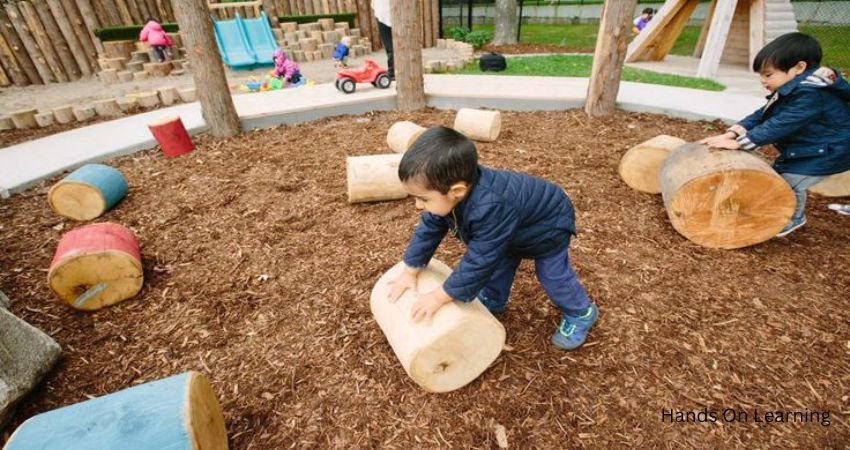
Hands-on experience is a learning experience in which a person learns through activities, experiments, or projects. It involves the use of senses, skills, and imagination to explore, discover, and acquire concepts. Intellect International Montessori School provides a range of practical experiences tailored to diverse learning styles and needs
Hands-on experience is a type of learning that presupposes direct contact with the environment and interaction with it. It not only enables children to learn through Theory but also allows them to learn, discover, and explore through practical activities.
Hands-on experience is essential for several reasons:
Increased retention: Practical experience enables learners to memorise information more effectively than traditional teaching methods.
Develop problem-solving skills: This will enable students to learn how to think critically and solve problems through practical experience.
Enhances creativity: Practical experience helps enhance creativity and innovation, as learners can experiment and learn new things, thereby gaining a clear understanding of the concepts.
Confidence: Additionally, there is the ability to become self-efficacious through practical work.
The benefits of practice experience are extremely great:
Improve critical thinking: The practical experience enables learners to develop their thinking skills by analysing, evaluating, and synthesising information.
Enhances cognitive development: Practical education is crucial for mental development, particularly in children.
Enhances STEM education: STEM education relies heavily on practical experience, which enables students to apply theoretical knowledge in addressing real-life problems.
Facilitates collaboration: The practical part often presupposes working in a group and encourages collaboration, communication, and teamwork.
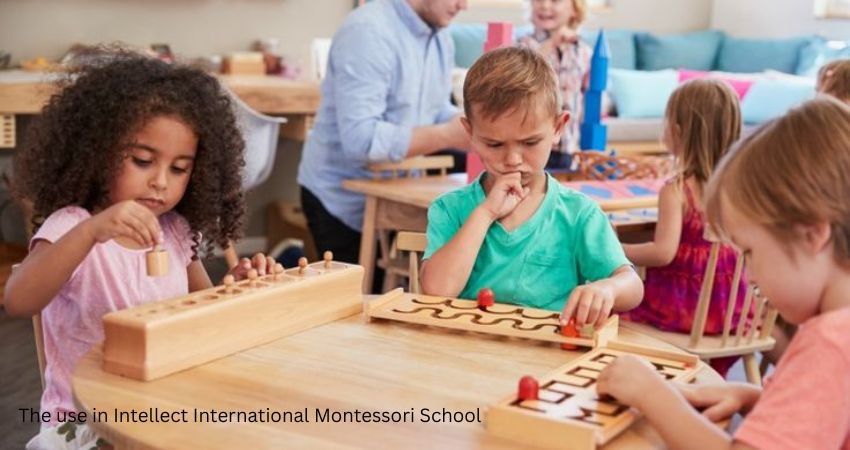
Our mission at Intellect International Montessori School is to provide a hands-on learning experience that is highly aligned with the Montessori philosophy. We have classrooms that allow us to learn independently, and our teachers are trained to teach us by doing critical thinking with our students to gain a cost-effective understanding of the real world and realise their full potential. The International Montessori School is broad-based and oriented towards Hands-on Science experiments, practical life activities, Montessori sensorial activities, Montessori materials, and child-led learning. In short, these are the areas:
Learning and teaching science at Intellect International Montessori School are conducted through age-related experiments that evoke curiosity. Our activities are well-planned, allowing children to be exposed to scientific concepts through hands-on experiences. The most popular exploration sites are:
Sink or Float (3-6 Years old)
Children do experiments using ordinary objects (leaves, coins, corks) in water
The lectures on the principles of Density and buoyancy
Ice Cube Colours (4-7 years)
The primary colours melt to create other colours in the ice cubes
Teaching: States of matter and colour Theory
Nature Rubbings (Ages All)
Leaves/bark drawing using crayons and paper
Teachings: Patterns in nature, Power to observe
Magnetic Treasure Hunt ( 5-8)
Students use magnets to find metallic objects that are buried in sand
Lectures: Magnetic characteristics and scientific classification
Experiments of this sort:
The practical life activities aim to ensure that children become independent, develop fine motor skills, and become coordinated. The activities will be similar to those in real life and will train self-reliance. Examples of activities in the practical life are :
Montessori development activities and sensorial activities are designed to help children develop their senses and gain a deeper understanding of the world. The Montessori sensorial activities provided at Intellect International Montessori School are:
Montessori materials are specially designed to promote independent learning and work. Montessori materials consist of some of the following:
The Montessori system is premised on active learning, also known as child-led learning. Children are also expected to take ownership of their learning process, where they are given freedom to learn new things at their own pace. The teachers serve as facilitators, providing guidance and support where needed. This will promote self-reliance, self-drive and learning interest. Children are also guided and taught in Montessori to take ownership and enhance their learning process. Teachers are supposed to be facilitators, able to direct and work with children to explore and learn at their own pace.
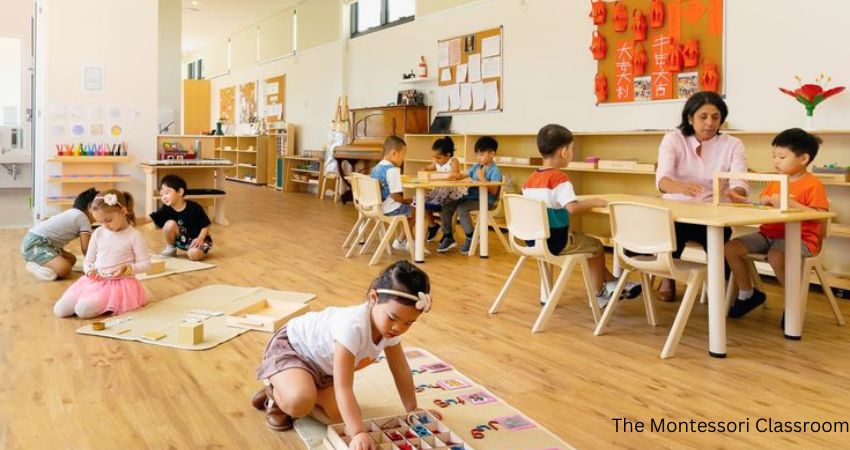
These real-life experiences help students gain a better understanding of the concepts, make significant connections, and fulfil their potential.
On-the-job training is a valuable way of learning that offers numerous benefits, including improved retention, enhanced problem-solving skills, increased creativity, and increased confidence. At Intellect International Montessori School, we ensure that a range of practical experiences is provided to accommodate diverse learning styles and needs. By incorporating practical experiences, we can make the learning process more interactive, engaging, and enjoyable, enabling individuals to be creative, think critically, and solve problems. The Montessori education provides students with an opportunity to explore, discover, and learn through practical experiences, which are an integral part of the Montessori approach. How much practical experience is needed in the overall development of a child? Students acquire a better understanding of the concepts through practical experiences, establish meaningful relationships and achieve their full potential. At Intellect International Montessori School, we are committed to creating an environment that fosters intellectual growth, creativity, and independence in our pupils.
The hands-on experience of Montessori learning is achieved through practical activities and experiences, allowing students to learn, discover, and explore by being directly involved.
Montessori sensorial activities refer to the activities that a child performs to develop their senses and become aware of the surrounding world. These activities include texture sorting, colour sorting, sound boxes, and smell bottles.
Practical experiences can be beneficial to students as they become proficient in problem-solving, and their thinking and creativity also develop, leading to improved retention and independence.
Yes, practical experience can be tailored to different age categories and learning needs, and therefore, a pragmatic approach to learning is beneficial.
Real-life learning promotes independence in learning, as students can take ownership of the learning process, become self-driven, and develop confidence.
The long-term benefits of Montessori education’s practical experience include the acquisition of critical thinking, problem-solving, and creativity, as well as the formation of a love of learning and enhanced academic performance.
It requires practical experience to improve retention, develop problem-solving skills, creativity, and confidence.
The benefits of real-life experience include the development of critical thinking, enhanced cognitive growth, a deeper understanding of STEM, and the promotion of teamwork.
Experience enables learners to apply theoretical knowledge to practical problems; therefore, STEM education is more engaging and valuable.
10. How does the practical experience in the curriculum of Intellect International Montessori School work?
We offer a range of practical experiences that cater to different learning styles and needs, including science experiments and Montessori sensorial activities.
At home, hands-on learning can be encouraged by allowing parents to provide their children with the chance to experiment, explore, and be creative.
Get all the latest information, support and guidance about the cost of living with kindergarten.
Start Registration