- Email helpdesk@brainsbuds.com
- Phone +92 306 3453603

Intellect International Montessori School nurtures young minds with a Montessori-based approach, fostering creativity, independence, and lifelong learning.
Monday to Friday: 7.45am – 1.00pm
Saturday, Sunday: Close
Email: helpdesk@brainsbuds.com
Phone: +92 306 3453603

Hello! Early childhood is the period of wonder, exploration, and blistering growth. Adults may not consider the importance of the smallest actions, such as pouring water into a cup, spooning rice out of a bowl to another, and folding a towel. However, in a Montessori setting, these fundamental tasks form the foundation of lifelong skills. They are not just chores, but rather lessons in focus, independence, and mastery. Why pouring, spooning, and folding are so important in early childhood, and more specifically, in the Montessori Method? You will discover how these simple acts help the body, mind, and spirit of a child develop.
Let us take a look!
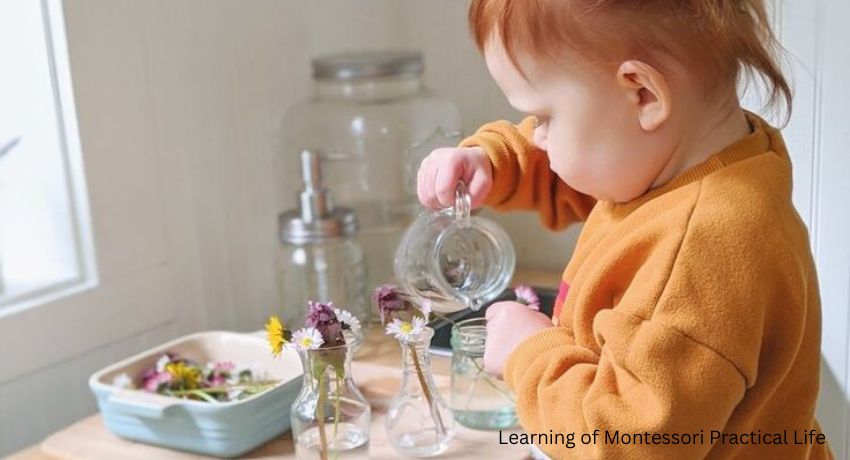
According to Maria Montessori, children learn in a meaningful way through deliberate action. The exercises in Practical Life are fundamental in Montessori settings, emphasizing skills representative of real-world activities. They include:
They are not mere chores — they are bids for independence.
Montessori referred to this period as a sensitive period for order and movement, implying that children are instinctively interested in learning about movements and routines. Through repetition of these simple activities, children develop concentration, coordination, confidence, and a sense of care for their surroundings
These activities seem to be insignificant, yet they cover nearly all spheres of child development:
What It’s:
Pouring means transferring liquids (such as water or juice) or dry products (such as rice or beans) from one container into another.
Montessori Approach:
Begin by pouring in the dry ingredients (beans, lentils), then add the liquids.
The Importance of It:
Applications of Daily Life:
Montessori Tip:
Never leave out a sponge or cloth. Spills are regular, and they are lessons, not errors.
What It’s:
Spooning is the use of a spoon to move solid items (such as grains, peas, beads) between two containers.
Montessori Approach:
The Importance:
Applications of Daily Life:
Montessori Tip:
Utilize real materials and fundamental tools. Plastic has a poorer ability to provide sensory feedback compared with metal or wooden spoons.
What It’s:
Folding refers to the process of bending a paper or fabric into specific shapes, usually in a neat and aligned manner.
Montessori Approach:
The Importance of It:
Applications of Daily Life:
Montessori Tip:
Add one new fold per time. Show slowly and silently so that observation and imitation will be encouraged.
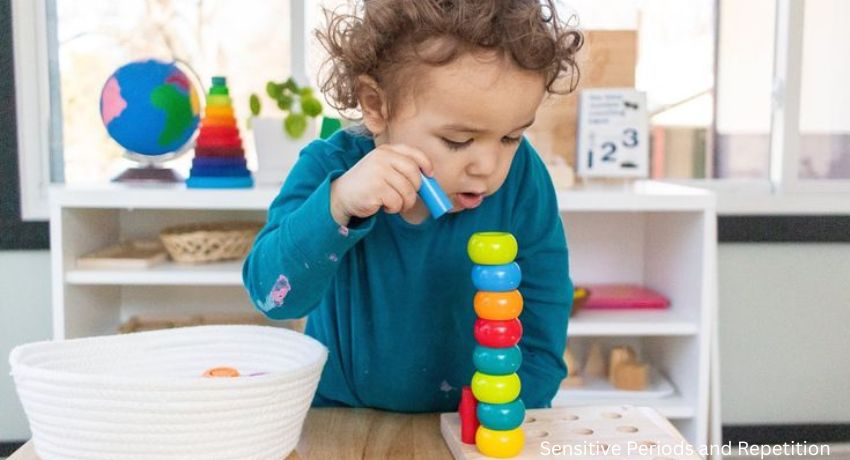
Maria Montessori also wrote about sensitive periods during early childhood when children are particularly keen to learn certain things. The movement, order, and independence are sensitive periods in which practical life activities are organized.
It is necessary to repeat. Children pour water over and over again, not to be silly, but to perfect one of the skills. What seems tedious to us is very satisfying to an emerging mind that craves a sense of mastery.
A Montessori-inspired environment does not require a complete kitchen makeover or costly toys. Easy measures can do a lot.
Toddlers (18 months- 3 years):
Preschollers (3 – 6 years ):
Liquids are poured in a cup or small bottle
Early Elementary (6 + years):
Apply these skills to meal preparation and clean-up
Academic Readiness
Fine motor control helps children hold a pencil, write letters, and turn pages. Math and reading are built upon sequencing and paying attention to detail.
Emotional Intelligence
Children are taught to handle errors, frustration, and take pride in their accomplishments.
Environmental respect
As a child folds a towel or pours without spilling, they internalize care, order, and mindfulness, which is extended to their treatment of people and spaces around
My child spills all the time.
That is a learning process. Give a piece of cloth and tell calmly, “We should clean it up together.” Spills decrease over time due to increased skills.
They soon get bored
Experiment with the materials: try spooning chickpeas instead of rice, or use a ladle instead of a spoon. In some cases, it is helpful to take a break and return.
When should I add a new step?
Once your child has mastered something and knows they do it, it is time to move on to the next stage of challenge.
It is all the little things that form the basis of a strong, confident, capable adult in Montessori. It is not trivial that pouring, spooning, and folding are transformative. They provide children with the means to understand the world through their hands, through their hearts, and their minds.
Such behaviors give children the ability to say: “I can do it by myself.”
And that few words open a life of self-reliance, self-esteem, and pleasure in the acquisition of knowledge.
Answer: Pouring helps develop fine motor skills, hand-eye coordination, and concentration. It teaches children control, patience, and cause-and-effect reasoning (e.g., pouring too fast leads to spills). These skills later support tasks like writing and self-feeding.
Answer: Spooning enhances problem-solving skills as children learn to scoop and transfer items carefully. It also improves precision, grip strength, and hand stability, which are essential for future academic tasks like holding a pencil or using scissors.
Answer: Folding strengthens finger dexterity, spatial awareness, and sequencing skills. It also promotes patience, attention to detail, and independence—qualities that help with school readiness and daily life tasks like organizing clothes or crafts.
Answer: By mastering pouring, spooning, and folding, children gain confidence in performing tasks without adult assistance (e.g., serving snacks, cleaning up). This self-sufficiency boosts their self-esteem and encourages responsibility.
Answer: Yes! Beginners can start with dry materials (rice, beans) before moving to liquids. Spooning can begin with larger items (pasta) before progressing to smaller ones (beads). Folding can start with simple folds (napkins) and advance to complex ones (origami).
Get all the latest information, support and guidance about the cost of living with kindergarten.
Start Registration